Safety Blog
Safety Blog
2022 ECI Employee Holiday Giving
We are proud to announce that our employees have collectively donated $21,483 which was divided between the following local charities:
- UVM Medical Cancer Foundation https://www.uvmhealth.org/medcenter/about-uvm-medical-center/foundation
- Vermont Make-A-Wish https://vermont.wish.org/
- Vermont National Guard Charitable Foundation https://www.facebook.com/Vermont-National-Guard-Charitable-Foundation-185255287247/
- Mike Loyer Foundation https://www.theclassicmikeloyer.org/about-us/
ECI also made a corporate contribution to the funds to bring the total up to an even $25,000 for this year.
ECI employees have a history of making charitable contributions during the holiday season and this is the largest contribution by its employees to date – exceeding last years contribution of $20,158.
In addition to the holiday giving, employees have purchased ECI sweatshirts and T-shirts throughout the year as part of another fundraising effort. The program raised $8,956 and all proceeds were donated to the UVM Cancer Foundation.
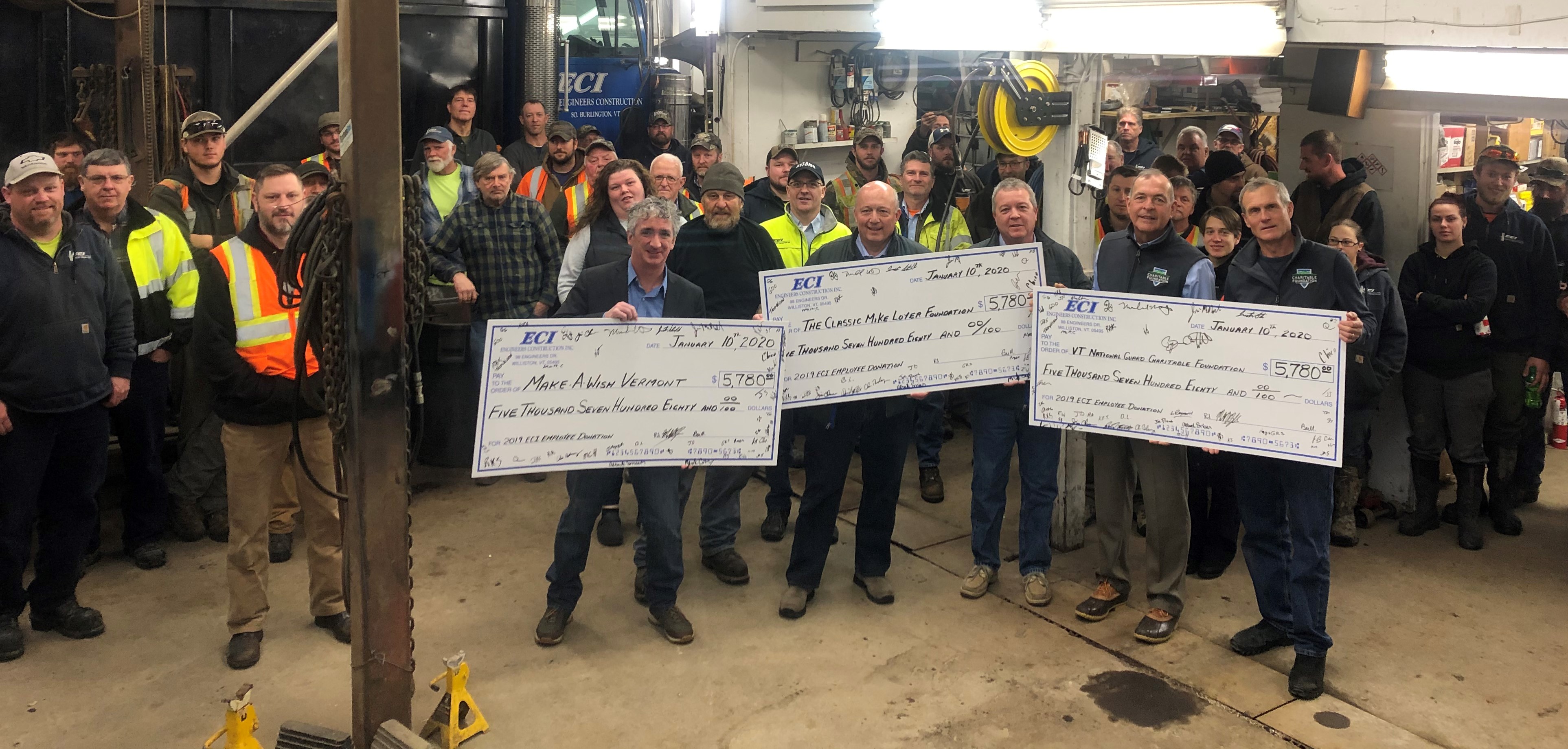
ECI Employees Contribute $19,672 to Local Charities for 2020
We are proud to announce that our employees have collectively donated $19,672 which was divided between the following local charities:
- American Cancer Society https://www.cancer.org/about-us/local/vermont.html
- Vermont Make-A-Wish https://vermont.wish.org/
- Vermont National Guard Charitable Foundation https://www.facebook.com/Vermont-National-Guard-Charitable-Foundation-185255287247/
- Mike Loyer Foundation https://www.theclassicmikeloyer.org/about-us/
ECI employees have a history of making charitable contributions during the holiday season and this is the largest contribution by its employees to date – exceeding last years contribution of $17,340.
ECI Employees Contribute $17,340 to Local Charities
We are proud to announce that our employees have collectively donated $17,340 which was divided evenly between the following local charities:
- Vermont Make-A-Wish https://vermont.wish.org/
- Vermont National Guard Charitable Foundation https://www.facebook.com/Vermont-National-Guard-Charitable-Foundation-185255287247/
- Mike Loyer Foundation https://www.theclassicmikeloyer.org/about-us/
ECI employees have a history of making charitable contributions during the holiday season and this is the largest contribution by its employees to date – exceeding last years contribution of $12.150.
ECI Recognized by Trenchless Technology Magazine for Middlebury Tunnel Project

ECI’s Middlebury Tunnel Project was highlighted in the May 2018 edition of Trenchless Technology. This early work package contract included construction of the deep stormwater conveyance tunnels for the upcoming railroad tunnel project. The three 60-inch-diameter tunnels in rock conditions were launched from a 40-ft-dia by 35-ft-deep launch shaft constructed in the heart of busy downtown Middlebury. The drives ranged from 140 to 152 feet long. The rock consisted of marble with an unconfined compressive strength of up to 20,000 psi. The third drive extended through the hard rock and into a mixed face and then a soft clay over the last 20 feet. ECI used a Robbins Motorized Small Boring Unit (SBU) tunneling machine with hard-rock disc-cutter tooling. The SBU is mounted at the front of steel casings which are jacked forward with an auger boring machine from inside the launch pit. The electrically motorized SBU head rotates as the steel casing transfers the applied jacking force from the auger boring machine system. The operator is inside the SBU-M and uses a laser-guided target to stay on line and grade. Steering is achieved by slight adjustments to the articulated forward shield. The tunnel is permanently lined by the trailing steel casing connected with permalok snap-on joints. This project used a 42-in-dia polypropylene corrugated steel pipe as the main carrier with annular grout fill.
Trenchless Technology Magazine: https://trenchlesstechnology.com/eci-robbins-sbu-m-three-hard-rock-crossings-vermont/prettyPhoto/0/
ECI’s involvement in the project will continue into the next phase of the railroad tunnel construction anticipated to start up this summer and completion in 2020.
VTrans Project Website: https://vtrans.vermont.gov/projects/middlebury
Robbins Company SBU-M Bochure: https://www.therobbinscompany.com/wp-content/uploads/2010/08/SBU-M-spec-sheet-2009_metric.pdf